Friday, November 21, 2014

Confections with Convictions


If you need a little extra comfort in your life in the midst of finals, I have good news: a new line of chocolate is available on campus. The bonus? It’s from a local business that’s making a huge impact in our community.
                  Last Tuesday the campus bookstore debuted Confections with Convictions’ chocolate bark and coated nuts. Dale Anderson, Kalamazoo native, started the chocolate shop four years ago to provide employment for previously convicted youth. As a counselor, he saw the lack of employment opportunities for these kids as an immense barrier to their growth as self-reliant adults.
                  Many kitchen experiments and a few culinary classes later and Anderson has a thriving chocolate business, currently employing five teenagers who have been through the court system in Kalamazoo. He shared a story about a young woman who hadn’t finished high school and was living at Kalamazoo Gospel Mission (a shelter that provides recovery services for people experiencing homelessness) when she started working at the shop. She has since completed her GED and is finishing school at KVCC this year. 
                  Anderson is also conscious of the global impacts of his operation. Upon learning about the slave labor in the Ivory Coast and Ghana – where 70% of the world’s cocoa beans is grown – Anderson committed to 100% fair trade sourcing. “If I was helping kids in Kalamazoo at the expense of kids in Ghana,” Anderson said, “it isn’t really win win.” Confections with Convictions also uses resource-conservative packaging and purchases local ingredients whenever possible.
                 
We can thank Ly Nguyen, K ’14 who volunteers at the chocolate shop, for bringing this delicious product to campus. “We wanted to have fair trade products but we didn’t know where to look or how to order,” Debbie Thomson, director of the bookstore said. In addition to connecting them with SERRVE, an organization that supports small-scale artisans and farmers around the world, Nguyen brought them samples of Anderson’s chocolate.
                  The bookstore now carries several flavors of bark – I tried dark chocolate with dried papya and pistachio – and ‘bites – assorted seasoned chocolate-coated nuts. Reasonably priced ($4 for 4 oz.), it makes a great gift to take home for the holidays. (I have to admit, my purchase was more of a self-indulgent pick-me-up.)

                  Stop by the shop (located less than 2 miles from campus at 116 W Crosstown Pkwy) and try one of 70 flavors of truffles - first one’s on Dale! Bring your student ID and receive a 5% discount through December.

Sunday, November 16, 2014

SweetStreet


            Sweetwater Donut and Water Street Coffee Twist made its debut as K College’s signature frozen yogurt flavor last Thursday. CEO and Founder, Pete Palazzolo, and Head of Accounts, Dave Seidel, set up in the caf during lunch to reveal the new flavor.
                  As a staff member working to promote efforts of sustainability in Dining Services, I was involved in the process of developing the flavor. We felt it was important to make it unique to Kalamazoo while supporting local businesses.
                  Pete took the time to visit with students at their tables, giving advice as a successful and proud entrepreneur. “It’s not as bad out there as you think,” he assured us. “I mean, it was bad when I first started and I still made it.”
                  Students lined up to sample the new flavors and the feedback was overwhelmingly positive. “Oh my god, it tastes like a donut!” I heard over and over, stunned expression after a first spoonful. “How do they do that?!”
                  Well, with donuts. Palazzolo’s blended Sweetwater’s glazed and Boston Crème donuts and steeped them in the cream as the base for the yogurt. This is essentially the process for making any of their over 200 flavors; steep the ingredient in the crème and then strain it out. 
Sweetwater’s has a stellar reputation on campus and the academic lifestyle often requires a caffeine boost. The combination made sense. Plus, coffee and donuts? It’s classic.
                   As for putting a name on our twist, take out the redundant ‘water’ and you end up with SweetStreet. We could feature the charming brick of Academy Street on the label…
Thoughts?


Wednesday, November 12, 2014

Michael Pollan Speaks to Kalamazoo Community

Michael Pollan, best-selling author and journalism professor at UC, Berkley, addressed a jam-packed Miller Auditorium last Thursday night. The Kalamazoo Community Foundation invited Pollan to talk with the Kalamazoo community about the importance of creating a healthy food system.
After the standard comments about the Glenn Miller song and Derek Jeter, Pollan presented his theme for the night: cooking.
Rather than vaguely covering the plethora of issues that plague our food system, Pollan focused on the one activity, the one essential skill that makes us distinct from other species. “Externalizing part of the digestion process,” or, more simply put, cooking.
The average American spends 27 minutes per day cooking. [If that sounds too high an estimation, which is scary in itself, consider that the market researchers’ definition of cooking is combining two or more ingredients. Making a peanut butter sandwich qualifies as cooking.]
According to Pollan, we’ve outsourced this innate and sensual process of preparing our nourishment.  He puts part of the blame on big food corporations who brought the daily activity of the home kitchen into the factory. As American citizens, particularly women, began to spend more time in the workplace a market opened up for convenience eating.
The commercial food industry seized the opportunity, and our food started to be ‘cooked’ in incomprehensible quantities, with the cheapest ingredients and most appealing packaging. But, as the consumers and demanders, we can’t blame the producers entirely. “We are all complicit in this system,” Pollan noted. 
He admitted that the ‘foodie’ movement annoys him as much as anybody at times, but he sees it as benign excitement. Excitement about remembering this innate practice that is so sustaining and life-giving. 

Carrie Pickett-Erway, President/CEO of the Kalamazoo Community Foundation,  selected several questions from the over 100 submitted. When asked how to make healthy food more accessible to low-income populations, Pollan said, “Well, we could start by paying them more!” Applause rippled from the audience.
It’s not about bringing local food costs down; “Your local farmer is not getting rich.” It’s about reexamining our government subsidies and restructuring our ‘living wage’.
Pollan thinks the next wave of the food movement will happen at the institutional level. It’s all about procurement; where are you buying the food you’re buying. “Corporations and institutions have incredible power to change the system.”
Pollan’s talk brought the systemic food crisis to a basic, personal level. What can we all do now to make a difference in the way we eat? Make a difference in the way we eat. 

Wednesday, November 5, 2014

Close-to-Kalamazoo Dinner


“Kale chips?! Oh my god. They have kale chips.”
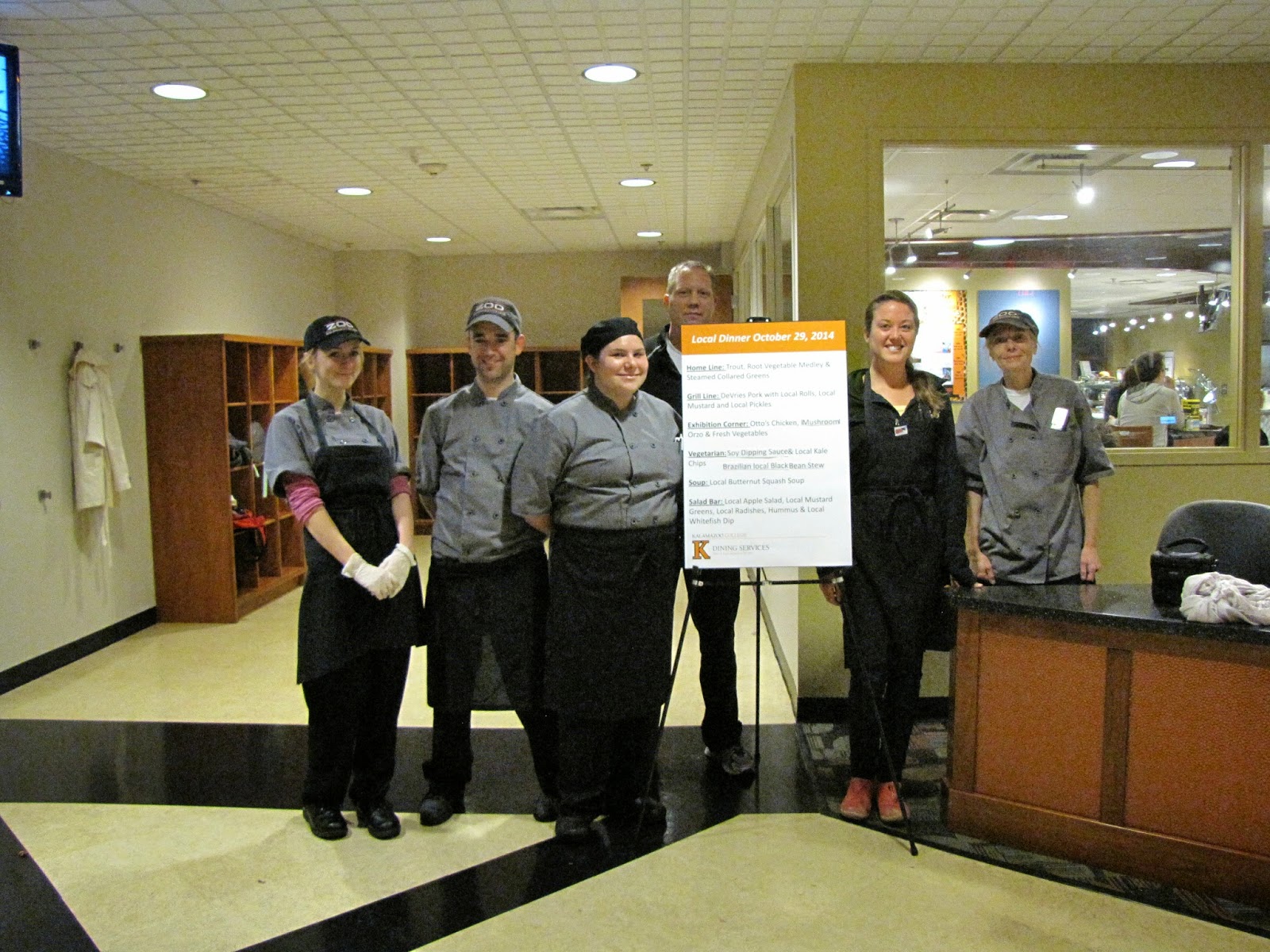
I heard countless variations of this comment as I enjoyed my apple crisp at the local dinner in the caf last Wednesday night. In collaboration with Farms to K, dining services put together a menu to promote local growers and producers in (belated) celebration of National Food Day.
October 24th was designated as Food Day in 2011 to inspire Americans to change our diets and our food systems. The organization ‘Food Day’ works toward a ‘vision of food that is healthy, affordable, and produced with care for the environment, farm animals, and the people who grow, harvest, and serve it’.
Our local dinner was one of thousands of national events promoting conscious action in improving our ways of eating. And, yes, for some that may include eating more kale chips. The novelty-turned-trendy snack food was arguably the most popular local item on the menu.
In case you too were distracted by the kale chips and overlooked the rest of the locally sourced offerings in your excitement, I’ve compiled a list. Look at what we can grow and produce so close to K’s campus!  


Monday, November 3, 2014

More Bang for your Cluck: The Benefit of Duck Eggs

Have you ever had a duck egg? Fried, over-medium, scrambled, or sunny-side up?
It’s comparable to a chicken egg in appearance and taste. A quick glance wouldn’t be enough to discern between the gray-white, rounded, seemingly translucent shell of a duck egg and the slightly smaller, cleaner shell of a white chicken egg.  Priced at $3 a dozen at the Bank Street Farmer’s market (the same price as chicken eggs), duck eggs and their subtle distinctiveness are worth experiencing.
I like my eggs over-medium - the whites completely cooked and the yolk mostly runny. I cook them in a pan with butter, olive oil, or coconut oil, and sprinkle with a pinch of salt and a hearty crank of a pepper.  
Until recently I’ve been following this procedure with chicken eggs, but when given the opportunity to try something new and different – like duck eggs - I usually take it.
A few weeks ago, I purchased my first dozen from Dwight Eichorn of Eichorn Family Farms. I bought two dozen - one chicken and one duck (he’ll even let you mix and match chicken and duck eggs within a dozen) - for $5.
At home, I did a side-by-side taste test, cooking them to my usual liking. The duck egg was slightly tougher to crack due to the thicker shell. It’s white was thicker which lengthened the cook-time but made it easier to flip. 
The differences that really matter are in the taste. The duck egg had a richer, more flavorful yolk. Its yellow was deeper, more golden, and provided a thick coat on a crust of toast. The white had a stronger, earthier flavor. With carefully monitored cooking one can achieve a much fluffier white from the duck egg, but a minute over and it will turn rubbery. (Bakers take advantage of the sturdier albumen, or ‘white’, of duck eggs, to increase the airiness in cakes)
A dozen of duck eggs gives you more bang for your buck. One egg has almost twice the calories as a chicken egg – 130 compared to 70. Duck eggs are also higher in protein (9 grams per egg), fat, and iron. They contain more omega 3 fatty acids because a duck’s diet includes more aquatic plants, fish, and fish eggs. To sum up, they’ll keep you full longer for less money and more nutrients!

Still rather uncustomary, I have yet to find duck eggs at a grocery store in Kalamazoo. I recommend a visit to Dwight’s table at the market on Saturday to get your first dozen.

Working at the Pinnacle: A K Grad's Experience

Chelsea Wallace ‘14 left Kalamazoo last week for an apprenticeship at the StoneBarns Center for Food and Agriculture in Poncantico Hills, New York. For six months, she’ll work to further the center’s mission of creating a consciousness about the effect of everyday food choices.
                  Blue Hill at Stone Barns is the zenith of high class farm-to-table dining. The restaurant uses food grown within a 250 mile radius and the offerings change daily, even hourly, depending on what’s ripe. Inspired by Dan Barber’s--co-owner and executive chef at Blue Hill--TED talk, Wallace sought an opportunity to work there.
                  Many facets of Wallace’s education at K influenced her interest in food. She had always loved food, but didn’t think much beyond enjoying the taste. “I didn’t even realize there was such a thing as a ‘food system’ ,” she said about her experience in Amelia Katanski’s ‘Cultivation Community’ seminar. “I called my mom and said, ‘Mama! There’s corn in everything! Everything! I can’t do this!”
                  And so began her quest to impact food systems she sees as problematic and work through challenges of food access in her community. She started by dropping her meal plan and cooking sophomore year. “I realized that food was something you could get involved in intellectually and creatively.”
                  In the fall of her senior year, her interest in food distilled through her Senior Individualized Project (SIP) work. She researched the effect of strawberries on insulin, triglycerides and glucose after ingestion of a high fat/carbohydrate meal (to read in full, search ‘Wallace’ in the SIP Cache). She realized that her favorite part of the process was preparing the breakfast for her eight participants. She wanted to be hands-on with food. “If you get to make delicious food that brings people together, why the heck not?”
                  Though she hopes to extend her visa next year, Wallace plans to eventually return to her hometown of St. Catherine, Jamaica. “Our food system is starting to look a lot like the American food system, which is not okay,” she said.
                  Wallace explained with incredulity that Jamaica spends over $1 billion on food and beverage imports per year. She hopes to work to improve their complex, import-dependent food system. “If we could become more food sovereign, that would help our economy, as well as farmers and communities and health,” she says. “If we don’t have good food – food that’s coming from a good source in our community, we’re not thriving.”